How to Take an Awe Walk
An awe walk is an ordinary walk taken with one intention: to notice things that are vast, beautiful or surprising. It takes fifteen minutes and costs nothing.
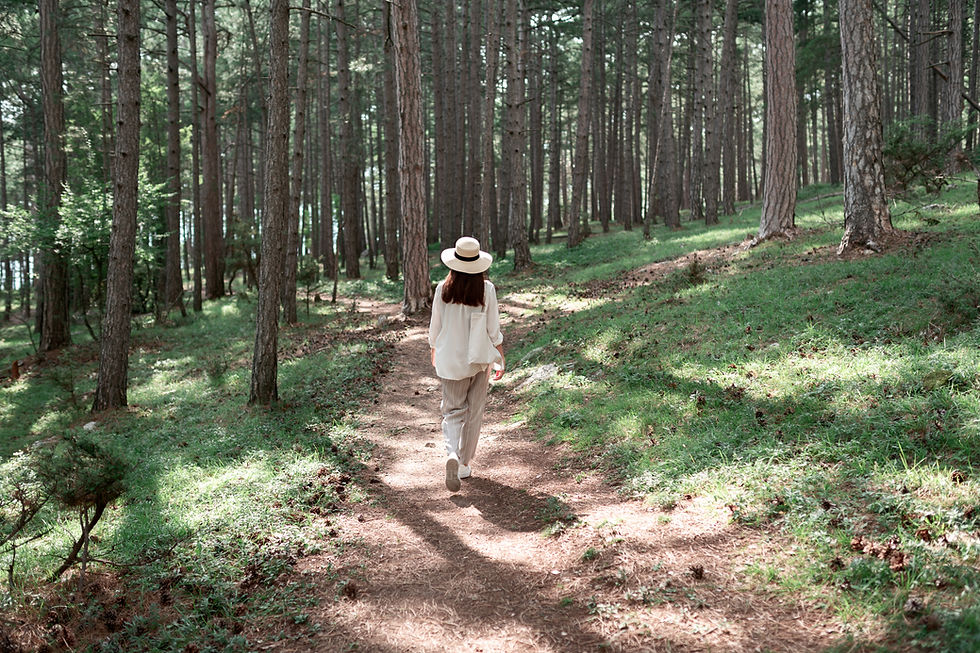
The essay The Path to Awe on this site draws on the work of psychologist Dacher Keltner, whose research and book on awe describe it as the feeling we get in the presence of something vast that we do not immediately understand: a night sky, a piece of music, an act of great kindness, the scale of a mountain. An awe walk is a simple way to go looking for that feeling on purpose. This guide explains the idea and how to try it.
What awe is
Awe is often described as having two parts. There is vastness, the sense that something is larger than us, physically, in time, or in meaning. And there is a need for accommodation, the sense that our usual way of understanding the world has to stretch to take it in. People describe awe as making them feel small in a good way, connected to something beyond themselves.
Awe does not require grand scenery. Researchers who have asked people around the world to describe experiences of awe have found that many happen in everyday settings: in nature close to home, while listening to music, or when witnessing other people's courage or goodness.
What research suggests
The idea of the awe walk became widely known after a study published in 2020 in the journal Emotion, by researchers at the University of California, San Francisco. Older adults were asked to take a short walk outdoors each week for eight weeks. Half were simply asked to walk; the other half were asked to approach their walks with a sense of wonder, noticing details with fresh eyes. The awe-walk group reported more positive, prosocial emotions in daily life, and the selfies they took on their walks gradually showed more of the landscape and less of themselves, along with bigger smiles.
It was a small study, and it does not show that awe walks treat any condition. But it fits a broader body of research on awe and on time spent in nature, and the practice is easy and safe for most people to try.
How to take an awe walk
- Choose a route. Anywhere you can walk safely for 15 to 20 minutes: a park, a trail, a quiet neighborhood, a riverbank, a city street at dawn. Somewhere new helps, but a familiar route works too.
- Leave the phone in your pocket. Silence notifications. If you want to take photos, take a few, deliberately, rather than scrolling.
- Start with a few breaths. Feel your feet on the ground and notice the air on your skin.
- Look up, look close, look far. Alternate your attention between the sky and treetops, small details at your feet such as moss, frost or the pattern of a leaf, and the farthest point you can see.
- Use every sense. Listen for the furthest sound. Notice smells: rain, cut grass, bread from a bakery. Touch bark or stone if it is safe to do so.
- Look for vastness. The size of the sky, the age of a tree or building, the number of birds in a flock, the light changing over a hill.
- Let yourself be surprised. Approach the walk as if you were a visitor seeing the place for the first time, or a child.
- Pause at the end. Before you go back inside, take a breath and recall one thing that struck you.
Making it a habit
- Try one awe walk a week, as in the study, and notice whether anything changes over a couple of months.
- Walk at a different time of day: early morning, dusk, or after rain.
- Keep a short note of one moment from each walk. Over time you build a personal record of wonder.
- Invite a friend, and agree to walk the first ten minutes in silence.
Awe beyond walking
Walking is only one route. Music is one of the most common sources of awe in people's accounts, which is why the original essay closes with a piece by Rachmaninov. Others include art, watching weather move across the sky, learning about the scale of the universe, and seeing people help one another. Pausing to notice those moments, rather than rushing past them, is a form of mindfulness in itself. Our guide to mindfulness exercises for adults includes other short practices that cultivate the same open attention.
Noticing what gets in the way
Most people find their attention pulled away within a minute or two: replaying a conversation, planning dinner, checking the time. That is normal, and noticing it is part of the practice. When it happens, take one breath and look for something you have not yet seen on the walk. Some people find it helps to give the mind a small job, such as finding five different shades of one color, or listening for the quietest sound around them. Others notice a habit of judging what they see as good or bad, pretty or ugly. An awe walk invites a different stance: simply letting things be interesting. You may also notice resistance, a feeling that this is silly or a waste of time. Let that be there too. You do not need to feel awe on every walk; the practice is in looking.
Walking safely
Choose routes that suit your fitness and mobility, dress for the weather and stay aware of traffic. If you have a health condition that affects walking, check with your doctor about what is right for you. An awe walk can be as short and gentle as a slow loop around a garden.